01
Double Eyelid Surgery
Creates or refines an upper eyelid crease using an incisional or non-incisional technique chosen for your eyelid.
Best for Monolids, faint or uneven creases
Learn more →From double eyelid surgery and ptosis correction to lower blepharoplasty and non-surgical under-eye care, every eye plan at The Beauty Plastic Surgery starts with a careful consultation. Our aim is a natural look that suits your face.
Start with the concern, not the procedure name. Upper eyelid concerns — no crease, an uneven crease, heavy or droopy lids, or a tired look from weak eye-opening muscles — are usually treated with double eyelid surgery, upper blepharoplasty or ptosis correction. Eye shape concerns, such as a covered inner corner or a short, upturned outer corner, are treated with eye corner surgery.
Under-eye concerns divide into two groups. Eye bags, hollows and tear troughs caused by fat, laxity or volume loss usually need surgery such as lower blepharoplasty or fat repositioning. Fine lines, thin skin, mild puffiness and dark circles can often be improved with non-surgical treatments such as boosters, fillers or lasers.
Many patients have more than one concern, so a combined plan is common. Send clear photos for a free online opinion, or read about double eyelid surgery and lower blepharoplasty to begin.
For creating or refining a crease, removing excess upper lid skin and strengthening eye opening.
Creates or refines an upper eyelid crease using an incisional or non-incisional technique chosen for your eyelid.
Best for Monolids, faint or uneven creases
Learn more →A small incision along the planned crease allows skin and fat to be adjusted for a defined, long-lasting fold.
Best for Thicker lids, extra skin or fat
Learn more →A suture method through tiny openings that forms a crease with shorter recovery and no long scar.
Best for Thin lids with little excess skin
Learn more →Eyelid surgery designed around East Asian eyelid anatomy to keep the crease natural and in proportion.
Best for A natural crease that suits your features
Learn more →Removes excess, sagging upper eyelid skin and, if needed, fat to refresh a heavy or tired upper lid.
Best for Hooding and age-related heaviness
Learn more →Corrects results from previous eyelid surgery, such as a crease that is too high, uneven or has faded.
Best for Unsatisfactory previous surgery
Learn more →Strengthens the muscle that lifts the eyelid so the eyes open more fully and look more awake.
Best for Droopy lids, sleepy-looking eyes
Learn more →For adjusting the inner and outer corners to change the width, angle and openness of the eyes.
Releases a fold of skin covering the inner corner so the eyes look wider and the crease flows more naturally.
Best for Prominent inner-corner fold
Learn more →Adjusts the outer corner to lengthen the eye horizontally or soften a sharply upturned angle.
Best for Short or upturned outer corners
Learn more →Tightens and supports the outer corner tendon to reshape or stabilise the corner without cutting it.
Best for Mild corner laxity or reshaping
Learn more →Lowers the outer part of the lower lid slightly to open the eye vertically and create a softer look.
Best for A gentler, more open eye shape
Learn more →An overview of inner and outer corner options and how they are combined with eyelid surgery.
Best for Comparing corner procedures
Learn more →For eye bags, loose lower lid skin and a tired under-eye area caused by fat or laxity.
Treats under-eye bags and loose skin by removing, repositioning or tightening tissue of the lower lid.
Best for Eye bags with skin laxity
Learn more →Reduces bulging under-eye fat, often through an incision on the inside of the lid with no visible scar.
Best for Puffy fat bags in younger patients
Learn more →Moves bulging fat into the hollow below it, smoothing the bag and the groove at the same time.
Best for Bags with a visible groove below
Learn more →Lifts and supports a lower lid that has loosened with age for a firmer, fresher contour.
Best for Sagging lower lids
Learn more →Tightens a lax lower eyelid to improve its shape and support against the eye.
Best for Loose or rounded lower lids
Learn more →Lifts the cheek tissue under the eye to soften a long lid–cheek junction and deep grooves.
Best for Under-eye ageing with cheek descent
Learn more →For hollows, deep tear troughs and sunken eyes, or correcting earlier fat grafts.
Surgically smooths the groove running from the inner corner down the cheek for a longer-lasting result.
Best for Deep tear troughs
Learn more →Uses a small amount of your own purified fat to restore volume to hollow under-eyes.
Best for Volume loss and hollowness
Learn more →Corrects lumps, overfilling or unevenness after previous under-eye fat grafting.
Best for Irregular results from past grafts
Learn more →Restores volume to a hollow upper or lower eye area so the eyes look less tired and deep-set.
Best for Sunken or hollow eye area
Learn more →For mild bags, hollows, thin skin and fine lines with little or no downtime.
Combines injections and energy treatments to reduce the look of mild eye bags without surgery.
Best for Mild bags, no time for surgery
Learn more →A soft hyaluronic acid filler placed carefully to smooth hollows and tear troughs.
Best for Mild to moderate hollows
Learn more →Platelet-rich plasma from your own blood used to support skin quality in the under-eye area.
Best for Thin skin, a natural approach
Learn more →Regenerative exosome care to calm and support thin, tired under-eye skin.
Best for Sensitive skin, recovery support
Learn more →A fine polynucleotide (PN) booster to help strengthen thin, crepey under-eye skin.
Best for Crepey skin and fine lines
Learn more →A collagen-stimulating booster that gradually improves firmness and texture under the eyes.
Best for Gradual firming, fine lines
Learn more →For skin tightening, texture and fine lines around the eyes.
Fractional CO2 laser resurfacing to refine texture and soften fine lines around the eyes.
Best for Wrinkles and rough texture
Learn more →Radiofrequency energy designed for the eye area to tighten loose eyelid and under-eye skin.
Best for Mild hooding and crepiness
Learn more →Focused ultrasound to lift and firm the brow and skin around the eyes without incisions.
Best for Early brow and lid heaviness
Learn more →Microneedling with radiofrequency to stimulate collagen and improve under-eye texture.
Best for Fine lines, texture, mild laxity
Learn more →Not sure which treatment fits? Start with the concern that bothers you most.
An overview of surgical and non-surgical ways to refresh a tired under-eye area.
Best for General under-eye ageing
Learn more →Treatment matched to the cause of your dark circles — pigment, thin skin, shadowing or hollows.
Best for Persistent dark circles
Learn more →Options for puffiness from fluid, fat or laxity, from non-surgical care to surgery.
Best for Morning puffiness and swelling
Learn more →Want to see results? View our eye surgery before & after photos.
General guidance to help you shortlist options before your consultation.
| Treatment group | Main concern | Anaesthesia | Typical downtime | Suggested stay in Seoul |
|---|---|---|---|---|
| Non-incisional double eyelid | Crease on thin lids | Local, often with sedation | About 1 week of swelling | About 5–7 days |
| Incisional double eyelid / upper blepharoplasty | Crease, excess skin or fat | Local, often with sedation | 1–2 weeks of visible swelling | About 7–10 days |
| Ptosis correction | Droopy lids, weak opening | Local, often with sedation | 1–2 weeks of visible swelling | About 7–10 days |
| Eye corner surgery | Eye width and angle | Local, often with sedation | About 1–2 weeks | About 7 days |
| Lower blepharoplasty / fat repositioning | Eye bags and grooves | Local with sedation or general | 1–2 weeks of swelling and bruising | About 7–10 days |
| Under-eye fillers & boosters | Hollows, thin skin, fine lines | Topical numbing | None to a few days | 1–2 days |
| Laser & energy treatments | Texture, laxity, fine lines | Topical numbing | None to about a week | 1–5 days |
General guidance only. Recovery and results vary between individuals and are confirmed at consultation.
A guided process from your first message to your flight home.
Send clear, front-facing photos of your eyes with eyes open and closed via WhatsApp for a first opinion and estimate.
A board-certified plastic surgeon examines your eyelids and discusses the design, technique, anaesthesia and risks with you.
Surgery is usually done under local anaesthesia, often with sedation. Non-surgical care is done with numbing cream.
After surgery, stitches are usually removed around day 5–7 and your recovery is checked.
Send photos as you heal. Most swelling settles in a few weeks, and results continue to refine over several months.
Practical tips for international patients visiting our clinic in Gangnam, Seoul.
Plan about 7–10 days in Seoul for most eyelid and under-eye surgery so stitches can be removed before you fly. Non-surgical care usually needs 1–3 days.
Most patients fly after stitch removal and their check-up. Bring sunglasses and keep your eyes moisturised on board.
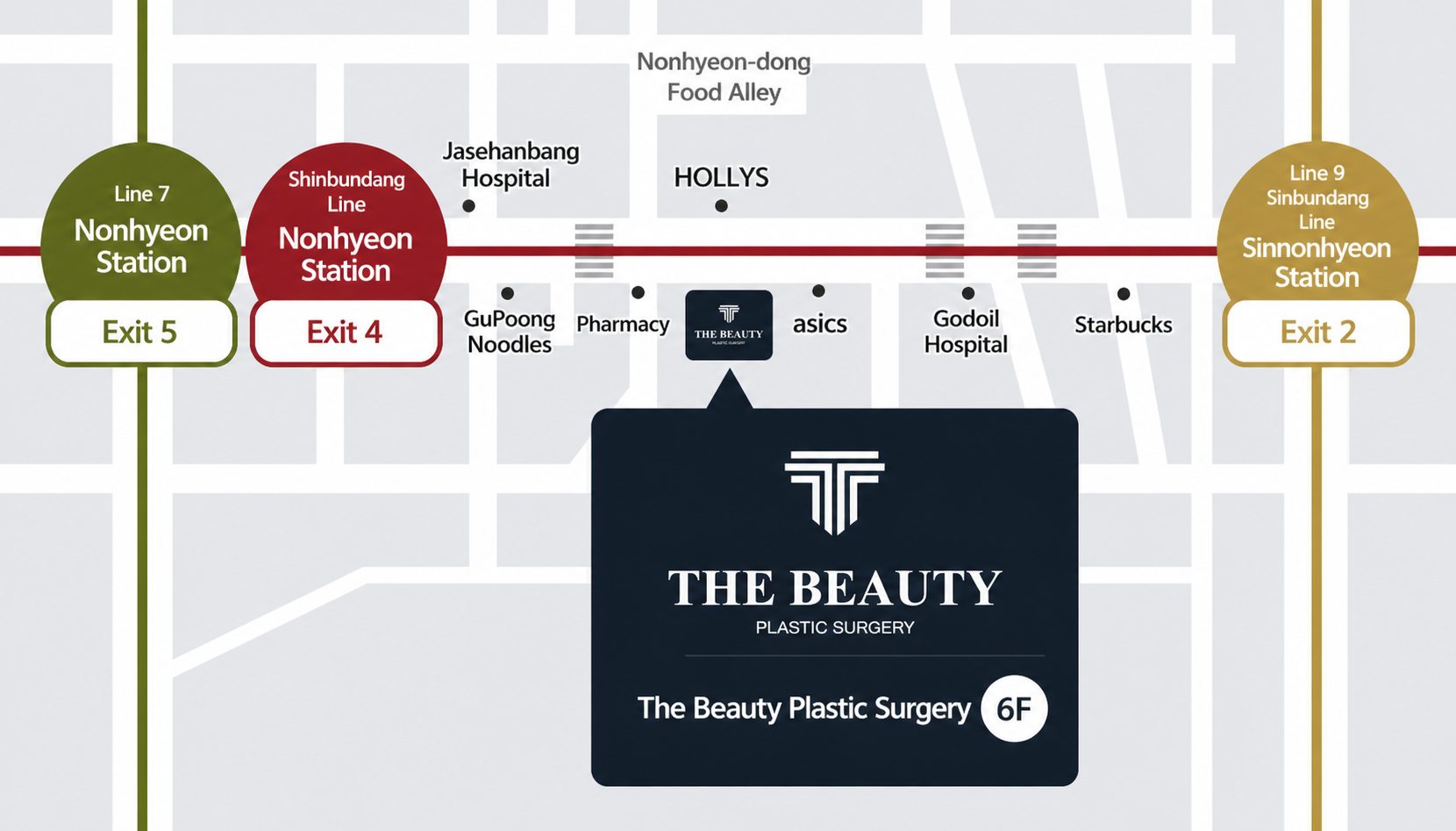
We are about 2 minutes from Nonhyeon Station (Line 7 Exit 5 / Shinbundang Exit 4) and 8 minutes from Sinnonhyeon Station (Line 9 Exit 2).
Consult with us in English before and during your visit. Chinese and Japanese support is also available.
The Beauty Plastic Surgery
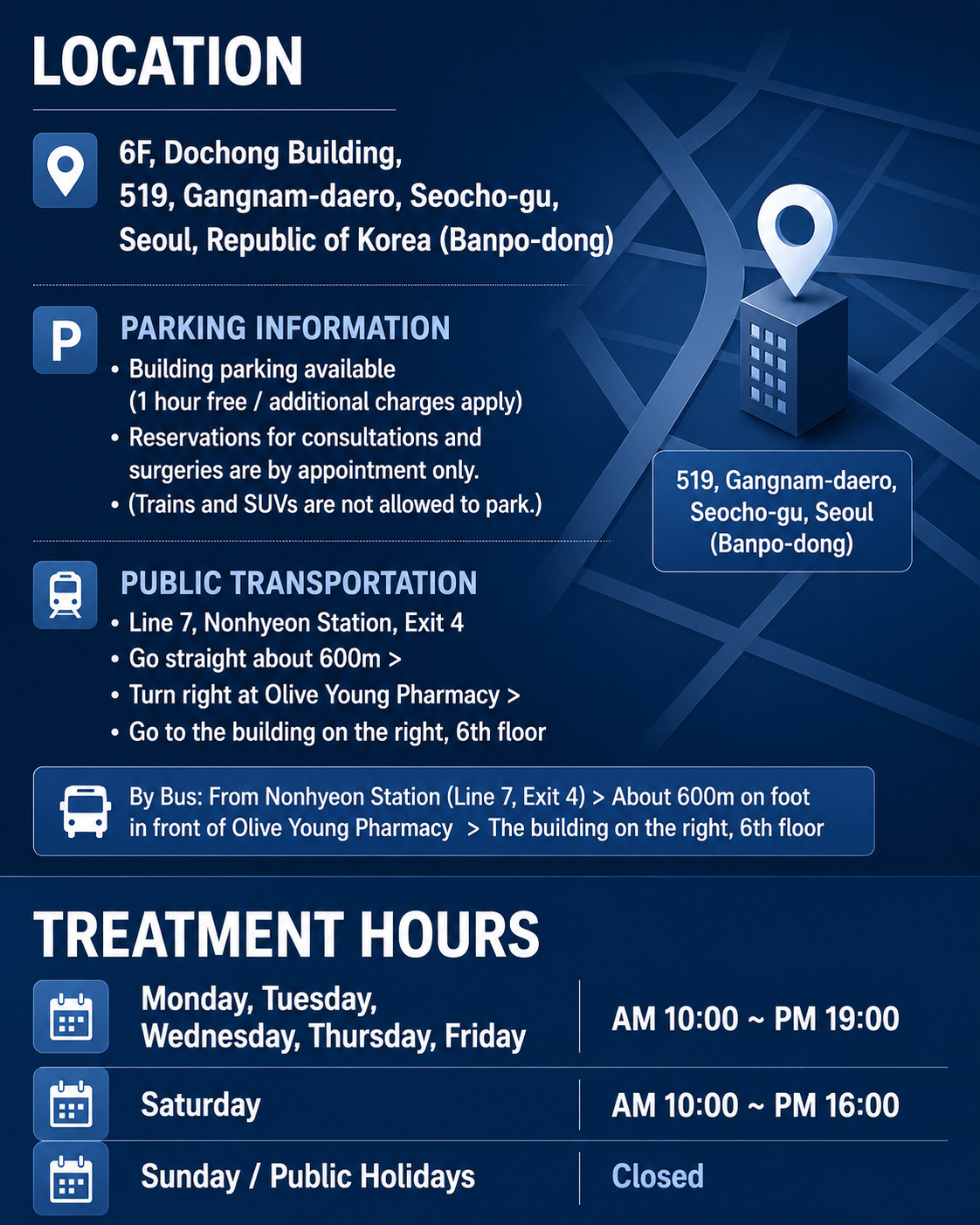
6F Dochung Building, 519 Gangnam-daero, Seocho-gu, Seoul, South Korea
서울 서초구 강남대로 519 도충빌딩 6층
Nonhyeon Station (Line 7 Exit 5 / Shinbundang Exit 4) — approx. 2 min walk
Sinnonhyeon Station (Line 9 Exit 2) — approx. 8 min walk
Mon – Fri: 10:00 – 19:00
Sat: 10:00 – 16:00
Sun & public holidays: Closed
Send us clear photos of your eyes and tell us your goals and travel dates. Our team will reply with suitable options and an estimated cost.
Results vary between individuals. This page is for general information and does not replace a medical consultation.
Our Location
Fill out this quick form to get expert recommendations tailored to your skin goals. No pressure, no obligation.

THE BEAUTY Plastic Surgery is a boutique clinic in Gangnam, Seoul, specializing in natural, refined results through personalized surgical design. From facelift and facial contouring to eye and nose surgery, our expert team delivers precise, advanced care. With English-speaking staff and a premium setting, we provide safe, seamless treatment for international patients.
6th Floor, Dochung Building, 519
Gangnam-daero, Seocho-gu, Seoul, Korea
Clinic Name: THE BEAUTY Plastic Surgery
Phone Number:
© 2026 All Rights Reserved THE BEAUTY Plastic Surgery Clinic