Endoscopic Brow Lift in Gangnam, Seoul — Minimally Invasive Lift Through Hidden Incisions
An endoscopic brow lift uses a small camera and short incisions behind the hairline to lift drooping brows and soften forehead lines. It usually means less visible scarring and a quicker recovery than a traditional brow lift. Each plan is designed by a board-certified plastic surgeon in Gangnam, Seoul.

What is an endoscopic brow lift?
An endoscopic brow lift is a minimally invasive version of the brow lift. Instead of one long incision, the surgeon makes a few short incisions hidden behind the hairline and uses a thin camera (endoscope) to see and release the tissues under the forehead. The brows are then lifted and secured at a natural height.
It can lift drooping brows, reduce some upper-lid heaviness caused by low brows, and soften horizontal forehead lines and frown lines. Because the incisions are small and hidden, scarring is usually less visible, and swelling and recovery tend to be shorter than with traditional techniques.
Comparing options? See our main brow lift guide.
Is an endoscopic brow lift right for me?
The endoscopic technique works best for patients with:
- Mild to moderate brow descent
- Good skin elasticity
- Early to moderate upper-face ageing
- Forehead and frown lines they want softened
- A normal hairline and forehead height
Endoscopic vs other brow lift techniques
Endoscopic lifting is not right for everyone. Very lax forehead skin or a very high forehead may need a different approach.
| Technique | Incision | Best for |
|---|---|---|
| Endoscopic brow lift | Short incisions behind the hairline | Mild–moderate brow descent, good skin elasticity |
| Hairline lift | Along the front hairline | High forehead with low brows |
| Sub-brow lift | Just under the eyebrow | Heavy upper lids; brow height acceptable |
| Temple lift | Hidden in the temple hair | Drooping outer brow and eye corner |
Your surgeon chooses the technique after assessing brow position, symmetry, forehead height, hairline, skin elasticity and eyelid hooding.
Why patients choose the endoscopic approach
What the endoscopic technique usually offers compared with a traditional brow lift.
Smaller incisions
A few short incisions hidden behind the hairline instead of one long incision.
Less visible scarring
Scars are usually concealed by the hair once healed.
Quicker recovery
Swelling is typically less, and most patients return to light activities in 7–10 days.
Natural expression
The brow is lifted at its source without a tight or surprised look.
How an endoscopic brow lift works in Seoul
A personalised plan, from your first message to your flight home.
- Before you fly
Online consultation
Send front photos with relaxed and raised brows via WhatsApp. We discuss suitability and plan your dates.
- At the clinic
Surgical planning
A board-certified plastic surgeon evaluates brow position, symmetry, forehead height, hairline, wrinkles and eyelid hooding, and explains risks.
- Surgery day
Surgery (1.5–3 hours)
Under general anaesthesia or IV sedation, the brow is released and lifted with camera guidance and secured in place.
- Week 1
Check-ups
Dressings are checked; stitches or clips are usually removed in about a week.
- Day 10–14
Final check
Your surgeon reviews healing before you fly home and explains aftercare.
Endoscopic brow lift recovery: what to expect
Typical milestones. Everyone heals at their own pace.
| Time | What is normal | What you can do |
|---|---|---|
| Days 1–3 | Swelling and bruising around the forehead and eyes | Rest with your head raised; cold compresses as advised |
| Week 1 | Swelling settles; stitches or clips usually removed | Light walks and a gentle routine |
| Days 7–10 | Bruising fades; forehead may feel tight or numb | Return to light daily activities; most patients can fly after the final check |
| Months 1–3 | Tightness and numbness gradually improve | Return to exercise when your surgeon agrees |
| Months 3–6 | Brow position settles | Final result becomes visible |
Possible risks include temporary numbness, asymmetry, hair thinning near the incisions and infection. They are uncommon and are monitored and managed by your surgeon.
Aftercare: what to do and avoid
Do
- Sleep with your head raised for the first week
- Use cold compresses as advised in the first days
- Wash your hair gently only when your surgeon allows
- Attend every check-up before you fly
Avoid
- Smoking and alcohol around the time of surgery
- Hair dyeing, perms or hot hair tools for several weeks
- Saunas, jjimjilbang and hot baths until cleared
- Strenuous exercise for about 3–4 weeks
Combining an endoscopic brow lift with other treatments
An endoscopic brow lift is often combined with upper or lower blepharoplasty, a facelift, fat grafting, laser resurfacing, RF microneedling or regenerative skin treatments. For example, a brow lift with upper blepharoplasty can treat both a low brow and excess eyelid skin.
Your surgeon will advise whether combining procedures is suitable and safe for you, and how it affects your recovery time and stay in Seoul.
Endoscopic brow lift in Seoul: frequently asked questions
Is an endoscopic brow lift better than a traditional brow lift?
Where are the incisions?
How long does recovery take?
Will my forehead feel numb?
How long do the results last?
How long should I stay in Korea?
Can I combine it with eyelid surgery?
How much does an endoscopic brow lift cost?
Do you have English-speaking staff?
Visit our brow lift clinic in Gangnam
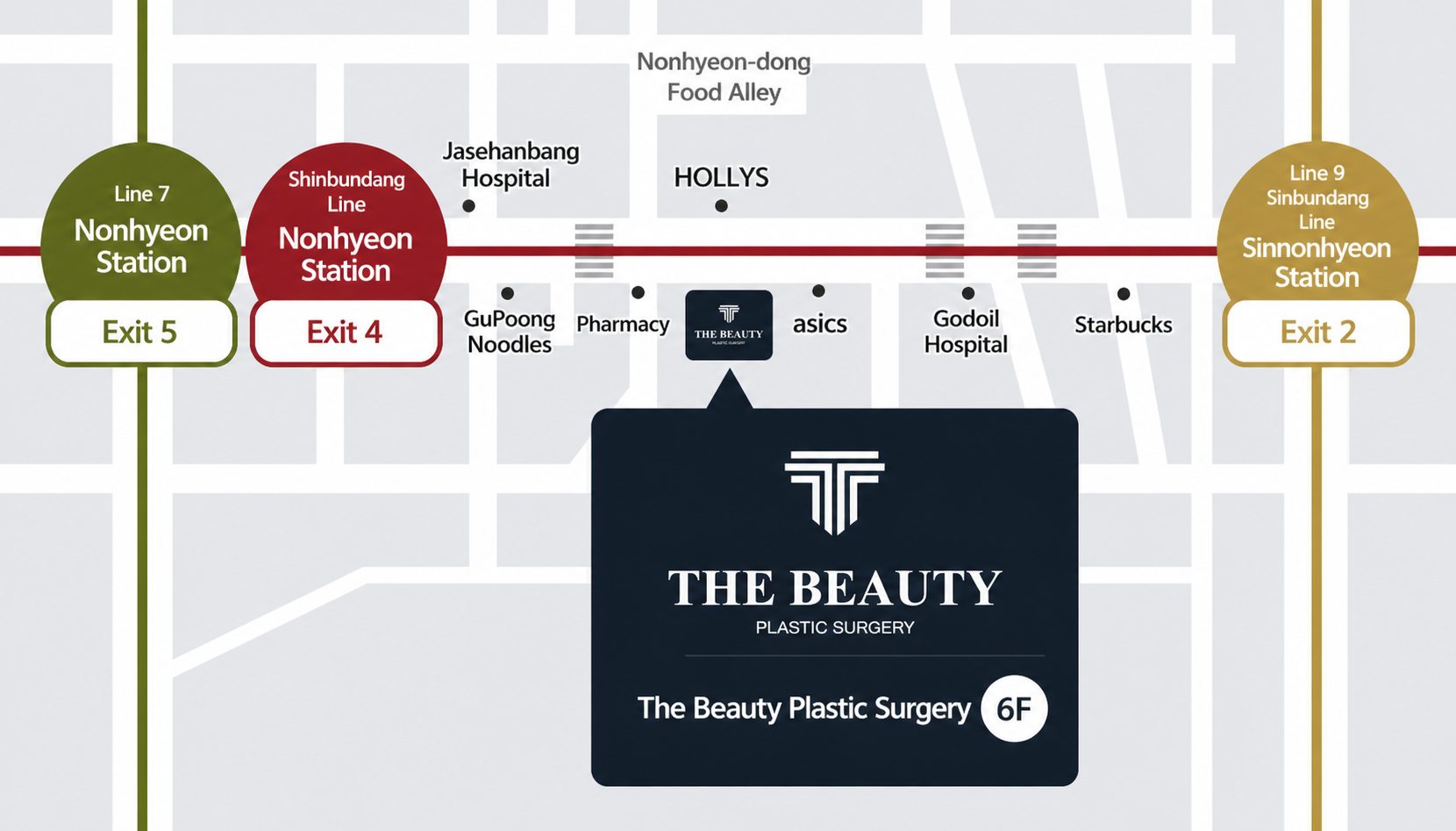
Address
The Beauty Plastic Surgery
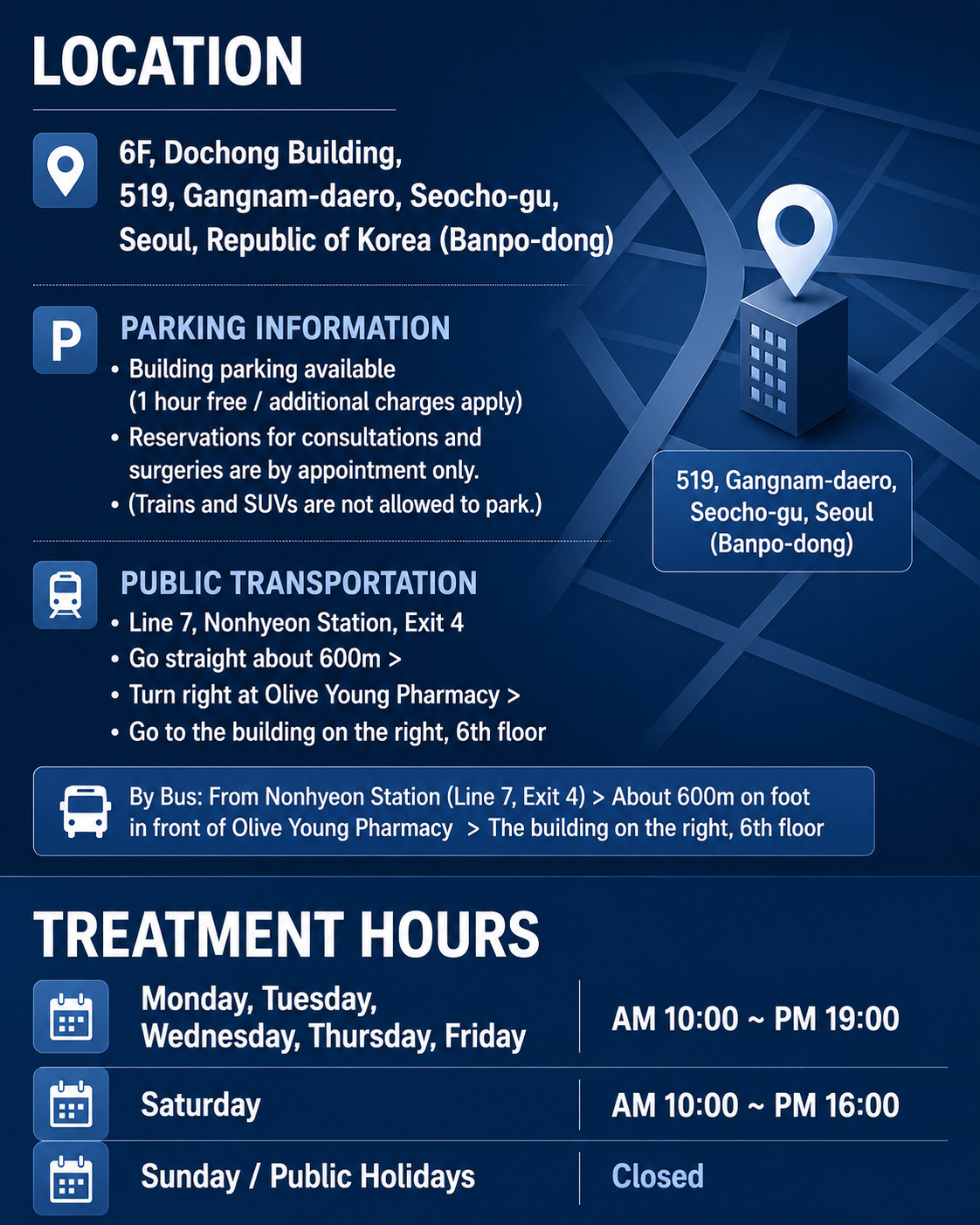
6F Dochung Building, 519 Gangnam-daero, Seocho-gu, Seoul, South Korea
서울 서초구 강남대로 519 도충빌딩 6층
Getting here
Nonhyeon Station (Line 7 Exit 5 / Shinbundang Exit 4) — approx. 2 min walk
Sinnonhyeon Station (Line 9 Exit 2) — approx. 8 min walk
Hours (KST)
Mon – Fri: 10:00 – 19:00
Sat: 10:00 – 16:00
Sun & public holidays: Closed
Get your personalised endoscopic brow lift plan
Send us front photos with relaxed and raised brows, plus your travel dates. Our team will reply with suitable options and next steps.
Results vary between individuals. This page is for general information and does not replace a medical consultation.