Lower Canthoplasty in Gangnam, Seoul — A Softer, Gentler Eye Shape
Lower canthoplasty gently lowers the outer part of the lower eyelid to open the eye vertically and soften a sharp or upturned look. Because the lower lid is delicate, it is planned conservatively by a board-certified plastic surgeon at our clinic in Gangnam, Seoul.

What is lower canthoplasty?
Lower canthoplasty — sometimes called lower eyelid lowering or “under-eye opening” surgery in Korea — repositions the outer part of the lower eyelid slightly downwards. This increases the vertical height of the eye opening towards the outer corner and can change an upturned, sharp or “fierce” eye shape into a softer, gentler one.
The change is small by design. The lower lid has to stay in firm contact with the eye to protect it, so the surgeon combines the lowering with support for the lid and keeps the correction modest. A good result looks naturally relaxed rather than obviously altered.
Lower canthoplasty is often combined with lateral canthoplasty or double eyelid surgery for overall eye balance.
Is lower canthoplasty right for me?
Not every eye can be safely lowered. Your surgeon checks lower-lid tension, eye prominence and tear function first. You may be a candidate if you have:
- Outer corners that tilt noticeably upwards
- A sharp or stern-looking eye shape you would like to soften
- Little visible white or iris below the outer pupil
- Good lower-lid tone and healthy tear function
- Realistic expectations for a subtle change
When lower canthoplasty may not be advised
Often suitable
- Upturned outer corners in healthy, firm lids
- A wish for a softer, friendlier expression
- Combination plans with outer corner surgery
- Patients who accept a modest change
Usually not advised
- Loose or weak lower lids
- Prominent eyes or visible white below the iris already
- Significant dry eye or tear problems
- Wanting a dramatic, deeply lowered lid
Lower canthoplasty vs related corner procedures
Three procedures at the outer corner, each with a different job.
| Procedure | Main goal | Change in eye shape | Often combined with |
|---|---|---|---|
| Lower canthoplasty | Lower the outer lower lid; open the eye vertically | Softer, less upturned outer eye | Lateral canthoplasty, double eyelid |
| Lateral canthoplasty | Lengthen the eye horizontally | Longer outer eye | Inner corner, lower canthoplasty |
| Canthopexy | Support and tighten the lower lid | Usually minimal | Lower blepharoplasty |
General guidance only. Your surgeon recommends the right approach after examining your eyelids.
How lower canthoplasty works in Seoul
Planned around your travel dates, from first message to flight home.
- Before you fly
Online consultation
Send clear front and side photos of your eyes via WhatsApp for an initial opinion.
- Day 1
Examination & design
The surgeon tests lid tension and tear function, agrees the design and explains risks and alternatives.
- About 1 hour
Surgery
Under local anaesthesia with sedation, the outer lower lid is released, lowered and anchored, then closed with fine stitches.
- Days 1–4
Rest & review
Cold compresses, head elevation and lubricating eye drops if prescribed; a check-up visit follows.
- Days 5–7
Stitch removal
Stitches are removed and most daily activities resume.
- Day 7–10
Pre-departure check
A final review of lid position before you fly home.
Lower canthoplasty recovery timeline
Swelling settles quickly, but the lid position needs months to stabilise.
| Time after surgery | What to expect | What helps |
|---|---|---|
| Days 1–3 | Swelling, bruising and a tight or watery feeling | Cold compresses, head raised, eye drops as prescribed |
| Days 5–7 | Stitches removed; most daily activities resume | Gentle cleaning; sunglasses outdoors |
| Weeks 2–4 | Most swelling settles; the lid may still feel firm | Avoid rubbing or pulling the lower lids |
| Months 3–6 | Lid position and scar settle into the final shape | Follow-up advice; sun protection |
General guidance only. Healing varies between individuals.
Planning lower canthoplasty in Gangnam from abroad
Practical points before you book your trip to Seoul.
Stay 7–10 days
Allows consultation, surgery, stitch removal and a final check of lid position before you fly.
Flying home
Most patients fly after their pre-departure check. Cabin air is dry, so bring the eye drops you were given.
Language support
English-speaking coordinators, with Chinese and Japanese support, help before, during and after your stay.
Getting here
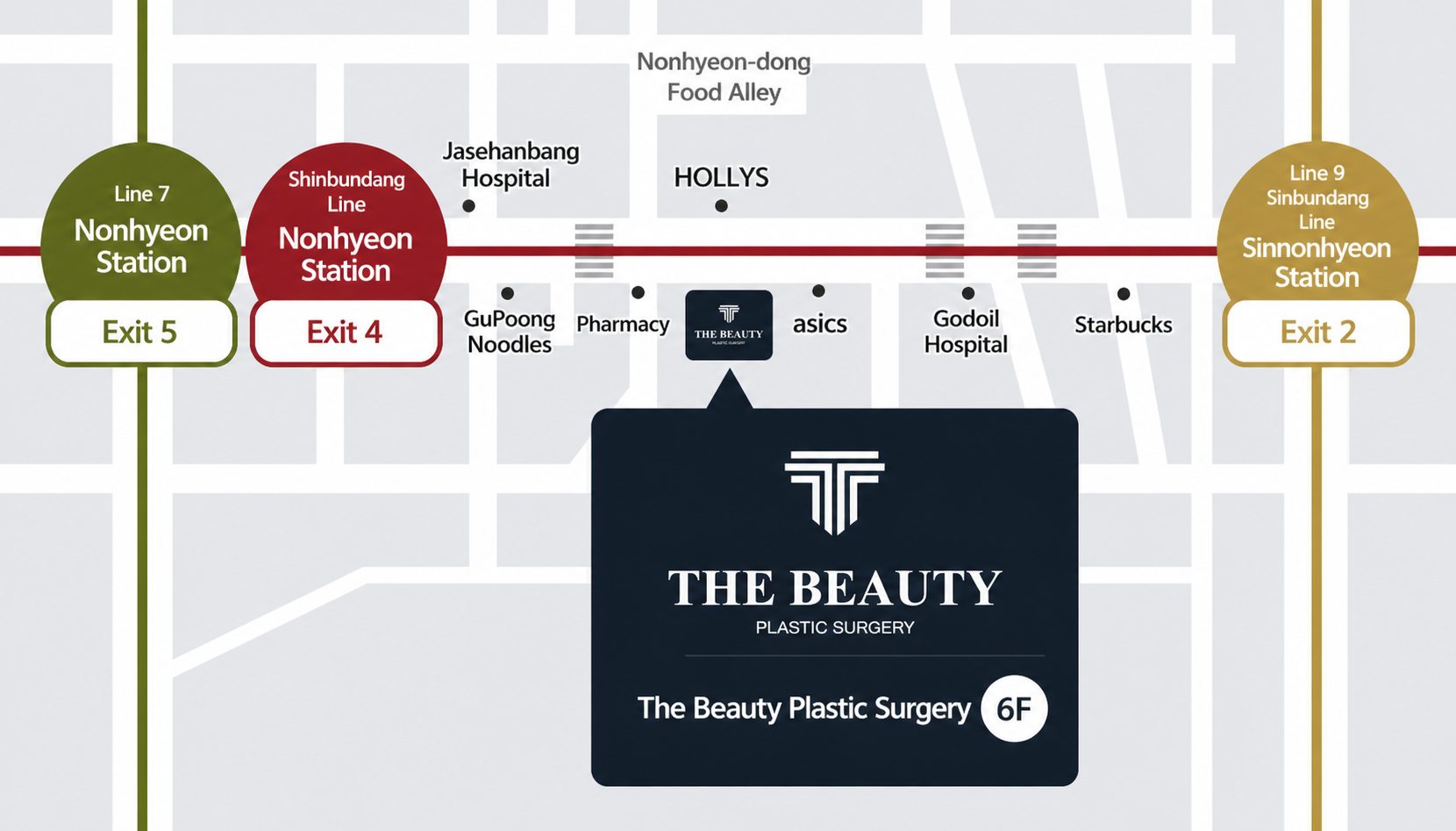
About 2 minutes from Nonhyeon Station (Line 7 Exit 5 / Shinbundang Exit 4); about 8 minutes from Sinnonhyeon (Line 9 Exit 2).
Aftercare after lower canthoplasty
Do
- Use cold compresses for the first 48–72 hours
- Sleep with your head slightly raised
- Use lubricating drops or ointment as directed
- Wear sunglasses outdoors and on flights
- Contact us on WhatsApp if your eye feels very dry or irritated
Avoid for about 2 weeks
- Rubbing or pulling down the lower lids
- Eye makeup and contact lenses until cleared
- Saunas, jjimjilbang and hot baths
- Alcohol, smoking and heavy exercise
- Swimming
Lower canthoplasty in Seoul: frequently asked questions
What does lower canthoplasty change?
Is lower canthoplasty the same as lateral canthoplasty?
Can the lower lid go back up after surgery?
What are the risks?
Will I have dry eyes afterwards?
How long should I stay in Seoul?
How much does lower canthoplasty cost?
Who performs the surgery?
Visit our eye surgery clinic in Gangnam
Address
The Beauty Plastic Surgery
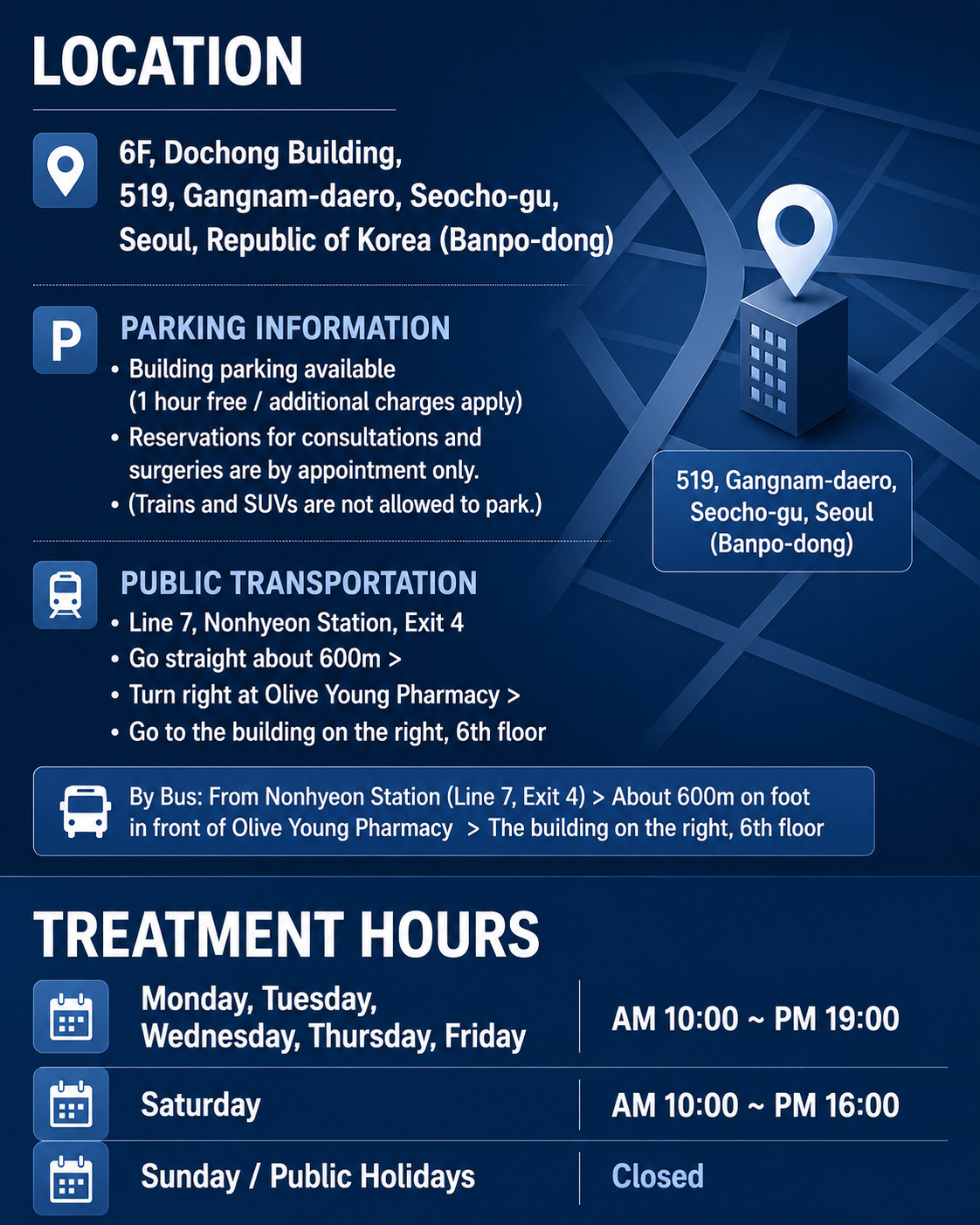
6F Dochung Building, 519 Gangnam-daero, Seocho-gu, Seoul, South Korea
서울 서초구 강남대로 519 도충빌딩 6층
Getting here
Nonhyeon Station (Line 7 Exit 5 / Shinbundang Exit 4) — approx. 2 min walk
Sinnonhyeon Station (Line 9 Exit 2) — approx. 8 min walk
Hours (KST)
Mon – Fri: 10:00 – 19:00
Sat: 10:00 – 16:00
Sun & public holidays: Closed
Get your personalised eye corner plan
Send us front and side photos of your eyes and tell us your goals and travel dates. We’ll reply with suitable options and an estimated cost.
Results vary between individuals. This page is for general information and does not replace a medical consultation.